⚠ Safety note: This guide involves working with electricity. If you're not completely sure about every step, stop and call a licensed professional. Before you start, always switch off the power at the breaker or close the main water/gas valve.
1 Verify that jump starting with cables is safe
Both vehicles must have the same nominal voltage, usually 12 V. Do not attempt if the battery is cracked, frozen, leaking, or smells strongly, nor on a hybrid or electric vehicle without the manufacturer’s manual.
2 Position the vehicles and turn off consumers
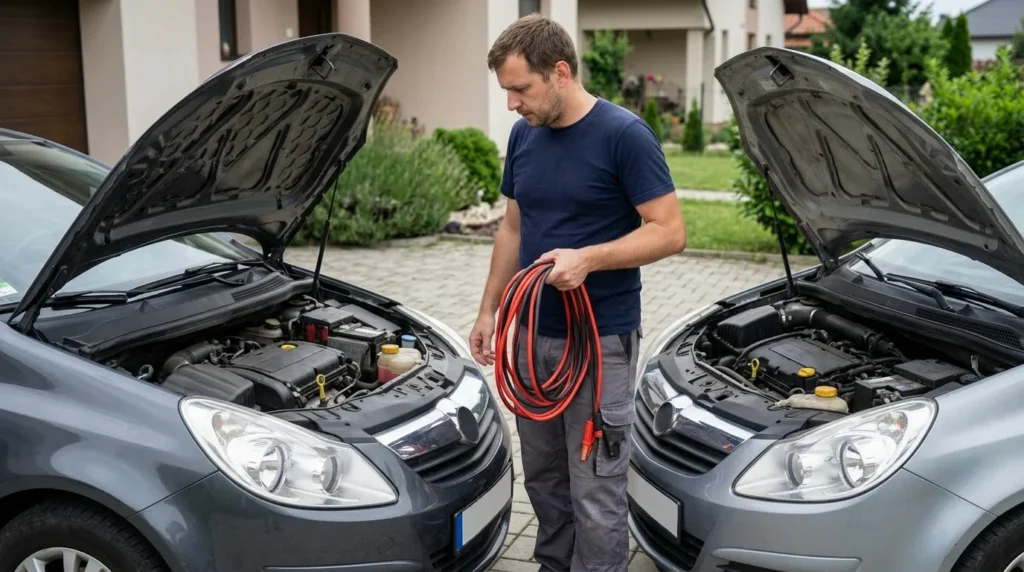
Bring the vehicles close together without touching, apply the handbrakes, put the transmissions in neutral or P, and turn off headlights, ventilation, and the radio.
3 Connect the cables in the correct sequence
Connect the red clamp to the positive terminal of the flat battery, the other red to the positive of the healthy one. Connect the black clamp to the negative of the healthy battery, and the last black clamp to a solid unpainted metal point on the engine or chassis of the vehicle being started, away from the battery.
⚠ Warning: Wrong polarity can instantly damage the electronics of both vehicles. If the terminal markings are not clearly visible, do not connect the cables blindly.
4 Start the vehicles without cranking too long
Start the helper vehicle and let it idle for a few minutes. Then try to start the other vehicle for a maximum of 5–10 seconds. If it does not start after two or three attempts, stop and look for the cause.
5 Disconnect the cables in reverse order
While both vehicles are idling smoothly, remove the black clamp from the ground of the started vehicle, the black from the helper vehicle, the red from the helper vehicle, and finally the red from the previously flat battery. Do not allow the clamps to touch.
? Tip: After a successful start, drive the vehicle for at least 20–30 minutes and check the battery and alternator if the problem recurs.
When to call a professional: If the job involves changes to the electrical panel, the main gas line, or load-bearing walls/beams — or if you're not sure how it will turn out — this is not a DIY task. Hire a licensed professional.