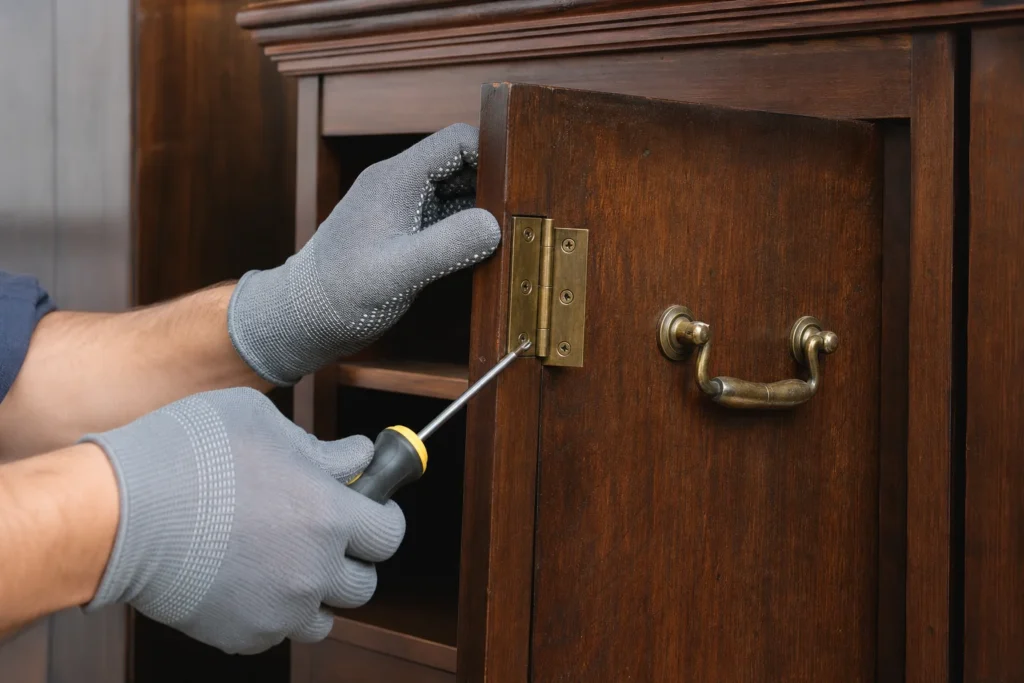
Wobbly cabinet doors and loose handles are the most common 'defects' of old furniture, and repairing them is almost always a matter of half an hour of work, not new furniture. By tightening the screws, repairing stripped holes, and lubricating the hinges, you restore a smooth opening and neat fit to the doors. This is the fastest and cheapest restoration you can do.
It is enough to know how to handle a screwdriver and a drill at a basic level.
1 Problem diagnosis
Close the doors and check if they hang, touch adjacent doors, or do not lie flat against the cabinet body – this will show you whether the problem is loose screws, adjustment, or a worn hinge.
? Tip: When buying new hinges, take the old one with you to the store to be sure you are buying the identical type and size.
2 Tightening loose screws
First, try simply tightening all visible screws on the hinges and handles with a screwdriver – often this is all that is needed to solve the problem.
3 Repairing a stripped screw hole
If the screw does not hold because the hole in the wood is stripped, fill it with wooden toothpicks dipped in wood glue, let it dry, and cut off the excess, then screw the screw back into the reinforced hole.
4 Adjusting modern hinges
For modern hinges with three adjustment screws, turn the appropriate screw: one moves the door left-right, the second up-down, and the third regulates depth, i.e., how much the door rests on the cabinet body.
5 Replacing a worn hinge
If the hinge squeaks, cracks, or no longer holds firmly regardless of adjustment, unscrew it completely and replace it with a new one of the same dimensions and load capacity, using the existing holes wherever possible.
6 Lubrication of moving parts
Apply a drop of silicone oil or specialized spray to the hinge joints and lock mechanisms to eliminate squeaking and facilitate movement.
7 Replacing and aligning handles
If you are replacing handles, check the distance between the screw holes (standard distances are 64, 96, or 128 mm) before buying to make sure the new handle matches the existing holes, or drill new ones if necessary.
Final check
- All screws are firmly tightened and holding — the repaired holes do not yield when you pull the door or handle
- Doors open and close smoothly and quietly, without squeaking or sticking, and fit flat relative to adjacent ones
- Handles are aligned and stand in the same line on all doors and drawers
Common problems
- The screw in the stripped hole just spins in place and cannot be tightened
- The hole is enlarged and the thread has nothing to grip. Remove the screw, push toothpicks or wooden sticks dipped in wood glue into the hole, break off the excess, let the glue dry, and screw back in — the screw will now have new, solid wood to grip.
- Vrata su i nakon pritezanja svih šrafova kriva — jedan ugao strši ili struže o okvir.
- If the hinges are modern (concealed cup hinges), use the adjustment screws on the hinge itself — one moves the door left-right, the second closer-further, the third up-down. For old flat hinges, place thin cardboard under one hinge or deepen its seat so the door sits flat.