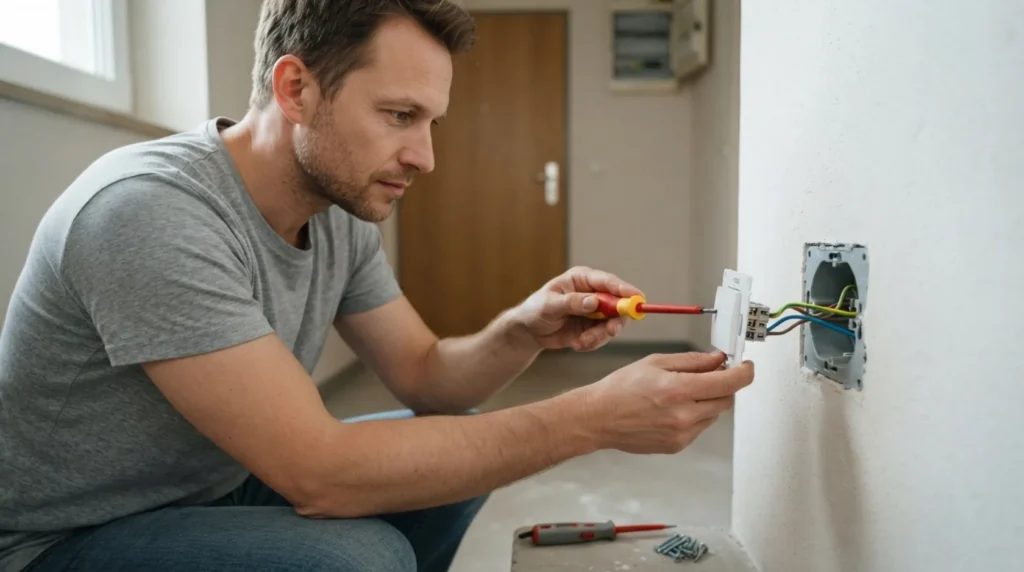
⚠ Safety note: This guide involves working with electricity. If you're not completely sure about every step, stop and call a licensed professional. Before you start, always switch off the power at the breaker or close the main water/gas valve.
1 Prepare for safe work
Switch off the corresponding fuse or main switch, prevent accidental reactivation, and confirm the absence of voltage with a two-pole voltage tester. If you cannot reliably identify the electrical circuit, stop working.
⚠ Warning: If you find multiple circuits, aluminum wires, scorched connections, or unclear wire colors in the junction box, the job must be finished by an electrician.
2 Determine the problem pattern
Identify the supply phase and the switched phase by measuring before turning off, mark them, and do not rely solely on the color of the old wiring.
3 Check the most common cause
On the disconnected circuit, connect the phase supply wire to L, and the switched return wire to the light to the marked output; neutral and protective conductors are not interrupted by a standard switch.
4 Apply the appropriate solution
Check the length of the stripped wire, the tightness of the terminal, and that no bare copper is visible before carefully putting the mechanism back into the box.
? Tip: Photograph the initial state and change only one thing at a time to know which check really affected the result.
5 Test the result and set the limit
Put the covers and safety guards back before switching on. Turn on the power from a safe distance and turn off immediately if a spark, odor, heat, humming, or a trip of the protection occurs.
When to call a professional: If the job involves changes to the electrical panel, the main gas line, or load-bearing walls/beams — or if you're not sure how it will turn out — this is not a DIY task. Hire a licensed professional.