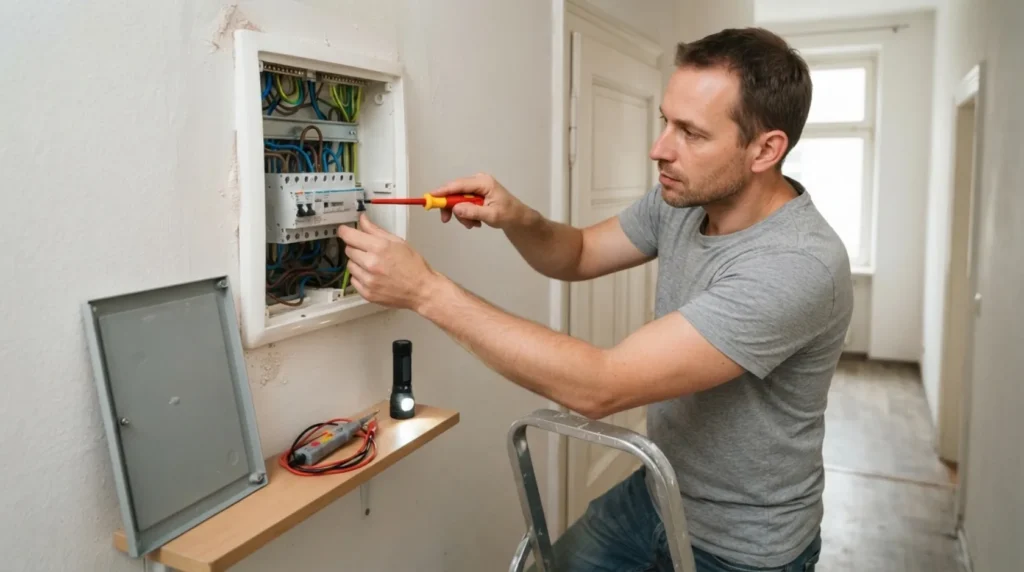
⚠ Safety note: This guide involves working with electricity. If you're not completely sure about every step, stop and call a licensed professional. Before you start, always switch off the power at the breaker or close the main water/gas valve.
1 Prepare a safe work area
Switch off the appropriate breaker or main switch, prevent accidental re-energizing, and confirm the absence of voltage with a two-pole tester. If you cannot reliably identify the circuit, stop working.
⚠ Warning: Measuring mains voltage is not a beginner task. If you do not have training and a meter with the proper CAT rating, use a two-pole tester with an electrician.
2 Identify the problem pattern
Check the measurement category, undamaged probes, and connectors: black in COM, red in V, never in the current input.
3 Check the most common cause
Select AC for mains voltage, DC for battery voltage, and a range higher than the expected value if the meter is not auto-ranging.
4 Apply the appropriate fix
Keep the probes behind the finger guards, connect the reference point first and the measurement point second, and do not change the function while they are connected.
? Tip: Take a photo of the starting state and change only one thing at a time so you know which check actually affected the result.
5 Test the result and set the boundary
Put the covers and guards back before switching on. Energize from a safe distance and switch off immediately if you notice sparking, smell, heat, buzzing, or the protection trips again.

When to call a professional: If the job involves changes to the electrical panel, the main gas line, or load-bearing walls/beams — or if you're not sure how it will turn out — this is not a DIY task. Hire a licensed professional.